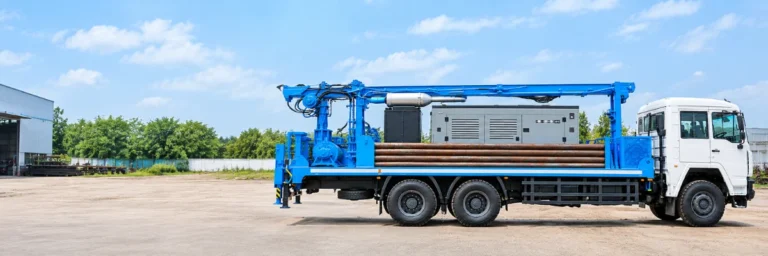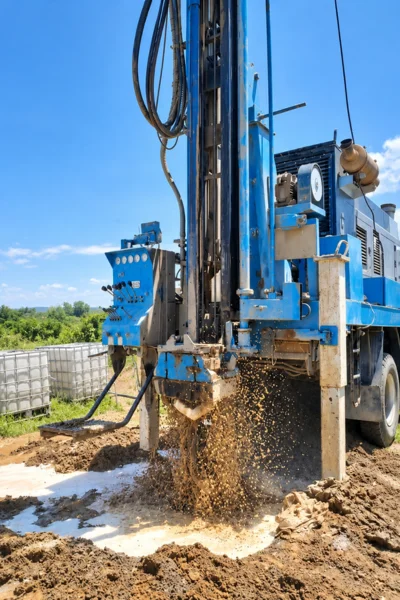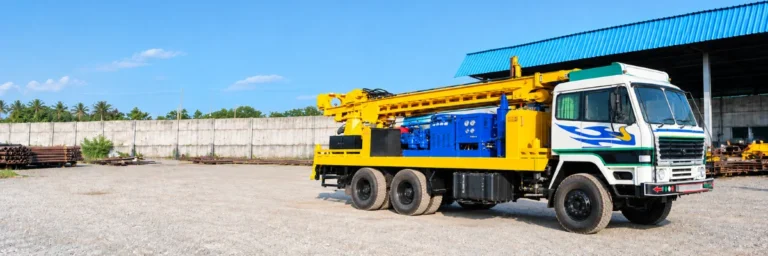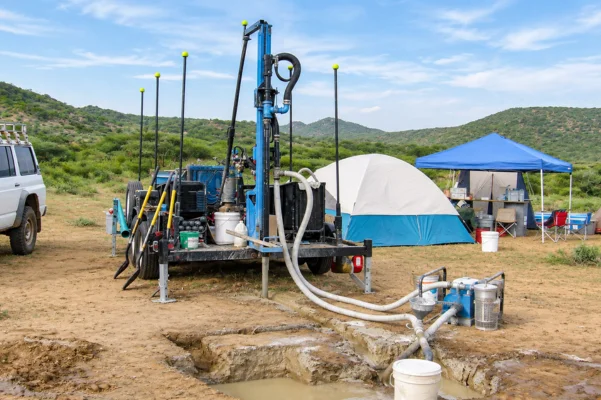
Down-the-hole (DTH) and rotary drilling are the two main methods for water boreholes. Choosing the right one, or a rig that can do both, has a big effect on penetration rate, cost per metre and the success of the hole.
How DTH drilling works
In DTH drilling a pneumatic hammer sits directly behind the bit at the bottom of the hole. Compressed air drives the hammer, which strikes the bit many times a second while the rig rotates the string slowly. The same air lifts the cuttings out of the hole.
- Excellent in hard, competent rock such as granite and gneiss
- Straight holes with consistent penetration
- Needs a compressor sized for the hammer, hole diameter and depth
How rotary drilling works
Rotary drilling cuts or crushes the formation by turning a bit, such as a tricone or drag bit, under weight. Drilling fluid (mud) or air carries cuttings to the surface and, with mud, supports the borehole wall.
- Suits soft, unconsolidated and mixed formations
- Mud supports collapsing sand and gravel
- Needs a mud pump and mud management on site
What this means in Zimbabwe
Much of Zimbabwe’s groundwater is found in weathered and fractured crystalline basement rock. A typical borehole drills through weathered overburden into harder rock, which is why DTH rigs, often with rotary capability for the top section, are common. Sedimentary areas with deeper sands and clays can favour mud rotary. Local knowledge of the area you drill is the best guide.
When a combination rig makes sense
A rotary-cum-DTH rig drills unstable overburden with rotary tools, sets casing, then switches to DTH in rock. It is the most flexible choice for contractors who meet varied ground, at the cost of carrying both a compressor and a mud pump.
Quick guide
| Ground | Usual method |
|---|---|
| Hard granite or gneiss | DTH |
| Weathered overburden over rock | Rotary or DTH with casing, then DTH |
| Loose sand and gravel | Mud rotary |
| Mixed and variable | Rotary-cum-DTH |
See our DTH rigs and rotary rigs, or describe your ground for a recommendation.
Questions
Can one rig do both DTH and rotary?
Yes. Rotary-cum-DTH rigs can drill soft overburden with rotary tools and switch to a DTH hammer in rock, provided the compressor and mud pump are both available.